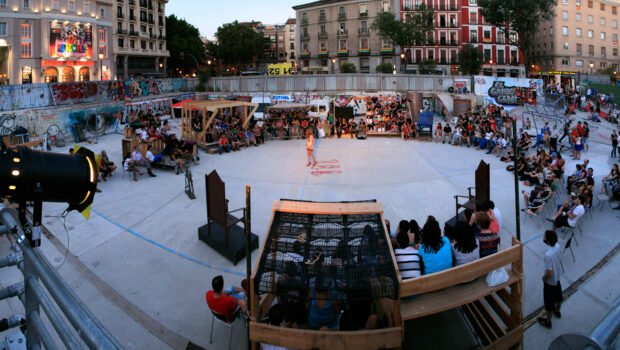
Vídeo del seminario ‘Del 15M a la #acampadasol’

Nuestro agradecimiento a Medialab-Prado, en cuya web se puede consultar el vídeo original: http://medialab-prado.es/article/investigacion_social_de_internet_y_las_tecnologias_digitales

  • Share/Bookmark
Posted in Uncategorized | Leave a comment

Del 15M a la #acampadasol: topologías para un experimento político urbano

El viernes 8 de julio a las 11.00 nos reunimos en Medialab-Prado (Madrid) para celebrar el tercero de los serminarios Empiria Digital. El título:  ‘Del 15M a la #acampadasol (o de Internet a la plaza): topologías para un experimento político urbano’ (convocatoria de Medialab-Prado). La discusión inicial la lanzarán Víctor F. Sampedro Blanco y José Manuel Sánchez Duarte (Universidad Rey Juan Carlos), María Luz Congosto (Universidad Carlos III) y Alberto Corsín Jiménez (Centro de Ciencias Humanas y Sociales – CSIC). Todos ellos han realizados análisis preliminares sobre algunos aspectos del 15M (enlaces más abajo) que servirán para organizar el debate inicialmente. La convocatoria a continuación.

En las últimas semanas, la Puerta del sol en Madrid y decenas de otras plazas por toda España, se han convertido en lugares para la experimentación política mediante la ocupación del espacio público y el ejercicio asambleario; dos prácticas a través de las cuales se convoca a la discusión de lo público a través de la implicación en las plazas públicas. Ese acontecimiento está estrechamente vinculado a la manifestación del 15 de mayo cuya convocatoria fue elaborada en los meses precedentes por diferentes iniciativas a través de Internet. Tanto un acontecimiento como el otro plantean toda una serie de interrogantes en torno a los modos de acción política que movilizan prácticas con genealogías diversas (Internet, movimientos de okupación) a través de las cuales se rearticula el espacio público de las plazas. El seminario pretende reflexionar sobre ello explorando algunas de las múltiples preguntas que se suscitan y, sobre todo, elaborando otras cuestiones que aún no hemos imaginado; entre ellas: ¿qué repertorios de prácticas específicas se movilizan en la convocatoria del 15M y en la acampadasol?, ¿qué relación hay entre ellas?, ¿cómo se transforma la topología urbana a través de ellas extiendo la acampada de Sol a otros barrios y ciudades?, ¿qué relación tiene la acampada en sol con los modos de okupación tradicionales?

Participan en el seminario Alberto Corsín Jiménez (Centro de Ciencias Humanas y Sociales – CSIC), Víctor F. Sampedro Blanco y José Manuel Sánchez Duarte (Universidad Rey Juan Carlos) y María Luz Congosto (Universidad Carlos III). Todos ellos/as son investigadores/as que han realizado análisis o relatos preliminares de lo que ha acontecido en estas semanas (más abajo las referencias), así que un segundo tema que se pretende discutir se refiere a la gestión de los tiempos y distancias en el análisis académico: ¿cómo gestionar la tensión entre la urgencia de los análisis que se solicitan y los tiempos por naturaleza dilatados del análisis social?, ¿cómo gestionar la distancia entre esos acontecimientos sociales y el contexto académico?, ¿es posible mantener esa distancia?, ¿es acaso necesario?

La red era la plaza, Víctor F. Sampedro Blanco y José Manuel Sánchez Duarte.

#spanishrevolution, Alberto Corsín Jiménez y Adolfo Estalella.

Del 15-M a la acampada de Sol, María Luz Congosto.

Evolución de la propagación del 15M en la plaza de Twitter, María Luz Congosto.

- Streaming desde: http://www.ustream.tv/channel/medialab-prado-general
- Lugar: Medialab-Prado. Plaza de las Letras. C/ Alameda, 15 Madrid (España), plano explicativo sobre cómo llegar.

  • Share/Bookmark
Posted in 15M, Empiria Digital | Leave a comment

#spanishrevolution (version 2)

Primer borrador / first draft

Over the past two months thousands of people have gathered in plazas and public spaces across local neighbourhoods in Spain. They have come together to constitute themselves into so-called ‘popular assemblies’. Theirs is a call to tomar la plaza: to take over the plazas and recuperate the barrio (neighbourhood) as a space of self-made political action – a making visible of the circuitry of do-it-yourself associative work that animates neighbourhood life.

In this sense, the assemblies are very much experiments in grassroots democratic self-organisation. Participants are not allowed to speak on behalf of political parties or partisan organisations. People attend on their own capacity, to speak in their own voice. Indeed, the assemblies have developed a democratic sign-language of their own. In the name of ‘respect’, participants are called to index their approbation or disapprobation of proposals by waving and gesturing their hands in an established etiquette. Proposals thus agreed turn into working groups staffed by volunteers. Different barrios are thus incarnating in different groups and projects their neighbourhood capacities. We will come back to the assemblies at the end.

The popular assemblies are a direct offspring of the #spanishrevolution (Twitter hashtag): the street protests that took over the urban landscape across the country in the days prior to the municipal and regional elections on May 22, and which originally drew some comparisons with the events at Tahrir Square in Egypt earlier this year. Although the historiography of the events is of course still very much in the making, a brief chronology of how things turned out is helpful.

Read More »

  • Share/Bookmark
Posted in 15M, Papers | Tagged , , , | 4 Comments

#spanishrevolution

Primer borrador / first draft

Over the past two months thousands of people have gathered in plazas and public spaces across local neighbourhoods in Spain. They have come together to constitute themselves into so-called ‘popular assemblies’. Theirs is a call to tomar la plaza: to take over the plazas and recuperate the barrio (neighbourhood) as a space of self-made political action – a making visible of the circuitry of do-it-yourself associative work that animates neighbourhood life.

In this sense, the assemblies are very much experiments in grassroots democratic self-organisation. Participants are not allowed to speak on behalf of political parties or partisan organisations. People attend on their own capacity, to speak in their own voice. Indeed, the assemblies have developed a democratic sign-language of their own. In the name of ‘respect’, participants are called to index their approbation or disapprobation of proposals by waving and gesturing their hands in an established etiquette. Proposals thus agreed turn into working groups staffed by volunteers. Different barrios are thus incarnating in different groups and projects their neighbourhood capacities. We will come back to the assemblies at the end.

Read More »

  • Share/Bookmark
Posted in Uncategorized | Leave a comment

Entre los mapas locativos y las esperanzas de revolución blogger

El segundo de los seminarios ‘Empiria Digital’ que se celebran mensualmente aborda dos temas diferentes el próximo 10 de junio. Susana Zaragozá presenta la investigación que realizó en la Universidad de Ámsterdam sobre mapas locativos.  Situándolo en el contexto de las iniciativas por mapear colectivamente el territorio, Zaragozá se aproxima al estudio de algunas prácticas locativas desde la teoría no representacional de Nigel Thrifht. El segundo tema del seminario lo presenta Adolfo Estalella, que discute una etnografía realizada sobre los que denomina bloggers apasionados centrada en el análisis de las esperanzas tecnológicas de transformación social. Su trabajo analiza específicamente la emergencia, circulación y las condiciones materiales de posibilidad de las esperanzas de transformar diferentes ámbitos de nuestra sociedad (política y medios de comunicación) a través de Internet. El seminario se celebra el próximo 10 de junio, entre las 11.00 y las 13.00, en el Medialab-Prado de Madrid. Más detalles sobre los seminarios en Empiria Digital y en Medialab-Prado.

Read More »

  • Share/Bookmark
Posted in Empiria Digital | Leave a comment

Seminarios Empiria Digital, un espacio para explorar la dimensión social de Internet (y lo digital)

Comenzamos nuestros seminarios de Empiria Digital para la discusión de investigaciones sobre los aspectos sociales de Internet y las tecnologías digitales. La primera sesión se celebra el 20 de mayo en Medialab-Prado Madrid (11.00-13.00). Habrá una presentación a cargo de Carla Estrella, antropóloga, titulada: ‘Una antropología de los mundos virtuales: avatares, comunidades y piratas digitales ‘ y otra de Jara Rocha, de la Universidad Carlos III, que presentará su proyecto de investigación sobre interfaces gráficas con el título de ‘La interfaz como dispositivo cultural de monitorización y gestión de la experiencia‘. El nombre de los seminarios, mensuales y con intención de continuIdad, se plantean como señala eso que de manera laxa se designa como ‘lo digital’ como lugar privilegiado para comprender algunos aspectos salientes de nuestra contemporaneidad. La discusión que aspiramos a entablar busca suministrar diversidad frente a los discursos homogeneizadores sobre Internet y las tecnologías digitales, desgranar las múltiples articulaciones de estas tecnologías, explorar las diversas culturas digitales y cuestionar en ese proceso los mismos límites de ‘lo digital’. Y no en menor medida, indagar en los desafíos metodológicos que se plantean en estos análisis.

Read More »

  • Share/Bookmark
Posted in Uncategorized | Tagged , , , | Leave a comment

New models for ‘cultural production’. The new is the culture, not the model

The Free Culture Forum (FCF) has published a document that under the title ‘How-To for Sustainable Creativity in the Digital Era’ made a strong defense of free culture and different strategists for promoting creativity inspired on it. The FCF is defined as “a space for creating tools and strengthening civil society in regards to the creation and distribution of art, culture and knowledge in the digital age”. Last November they celebrate their second meeting in Barcelona. After it, they have published the How-To for Sustainable Creativity… a declaration whose point of departure is very simple: “Many of the old models no longer work. They have become unsustainable and detrimental to civil society. We need to define and promote innovative strategies that make cultural practices sustainable and empower the wealth of society in general”. And following this statement they elaborate a long argument in favor of models for a “sustainable creativity”. I completely endorse the main principles of the declaration, although I don’t agree with their arguments. Paradoxical perhaps? I don’t think so.

Read More »

  • Share/Bookmark
Posted in Procomún | Leave a comment

Prototyping: a sociology in abeyance

Along with our ethnographic piece (to which you’ll find a video-link in a previous entry), we further contributed a slightly more theoretical piece to the ‘Prototyping prototyping’ Episode which Chris Kelty directed for the Anthropological Research on the Contemporary Studio.

It is an unsually long entry, but we thought it was worth embedding it here too:

PROTOTYPING: A SOCIOLOGY IN ABEYANCE
Alberto Corsín Jiménez and Adolfo Estalella (Consejo Superior de Investigaciones Científicas)

Could we speak of a saint as a prototype for a religious movement or of a clue as a prototype for a crime?

Writing in the early 20th century, philosopher Max Scheler thought that heroes, saints and geniuses played a prototypical role for larger models of social organisation.[1] Scheler was interested in the distribution of ethical values across societies. Insofar as a saint was a role model for society, his character and charisma would indeed count as prototypical of certain value structures. The prototype carried a combined sociology of leadership and organisation. It released charismatic and transcendental values of significance for society as a whole. It spilled-over or ‘externalised’, as today’s economists might put it, ethical goodies. The prototype as a public good.[2]

Read More »

  • Share/Bookmark
Posted in Prototyping | Tagged , , | Leave a comment

Arduino and the storytellers

What happens when the political economy of free/open source software is translated to the production and circulation of physical objects? This is one of the questions that intrigues me about Arduino. I attended last Friday the premiere in Medialab-Prado of a film that tells the history of this electronic project under the title Arduino. The documentary. For those not into the world of electronics, Arduino is an Open Source hardware that tries to translate the philosophy of Free and Open Source software into electronics. It is defined as:

an open-source electronics prototyping platform based on flexible, easy-to-use hardware and software. It’s intended for artists, designers, hobbyists, and anyone interested in creating interactive objects or environments. Arduino can sense the environment by receiving input from a variety of sensors and can affect its surroundings by controlling lights, motors, and other actuators…

The main idea of free/open source software (this of free flow of knowledge without the restriction imposed by copyright; ok, it is much more than this) has been translated into very different domains like music, books and movies (I wrote about it when I worked as a journalist, even on open source hardware seven years ago!). In all these cases we are dealing with non-material objects that circulate easily on the Internet; but what happens when the political economy of open source is translated to the production and circulation of material objects that cannot travel instantly and so easily around the globe? This situation is closer to the classical work (v.g. Mauss) that has sometimes been used for approaching the analysis of free software. But while there is a huge literature of social analysis of free/open source software there is still very limited work on open source hardware. It is not so strange if we consider that the first Open Source Hardware Definition was published last week! But leaving this aside, I guess that there are many issues to be discussed. A small example of the implications of the physicality of objects: one of the advantages of Arduino is the reduced price of their electronic boards: around 30 dollars (sometimes three or four times below the price of similar products); however, when you send a board to some countries in South America it is taxed with 100 dollars in the custom. The price advantaged is lost.

Read More »

  • Share/Bookmark
Posted in Prototyping | Leave a comment

Episode 3

Building on our ‘Prototyping cultures’ conference, Chris Kelty has just directed a new Episode on ‘Prototyping prototyping’ for the Anthropological Research on the Contemporary Studio. The Episode is available here.

  • Share/Bookmark
Posted in Experimentation, Prototyping | Leave a comment